
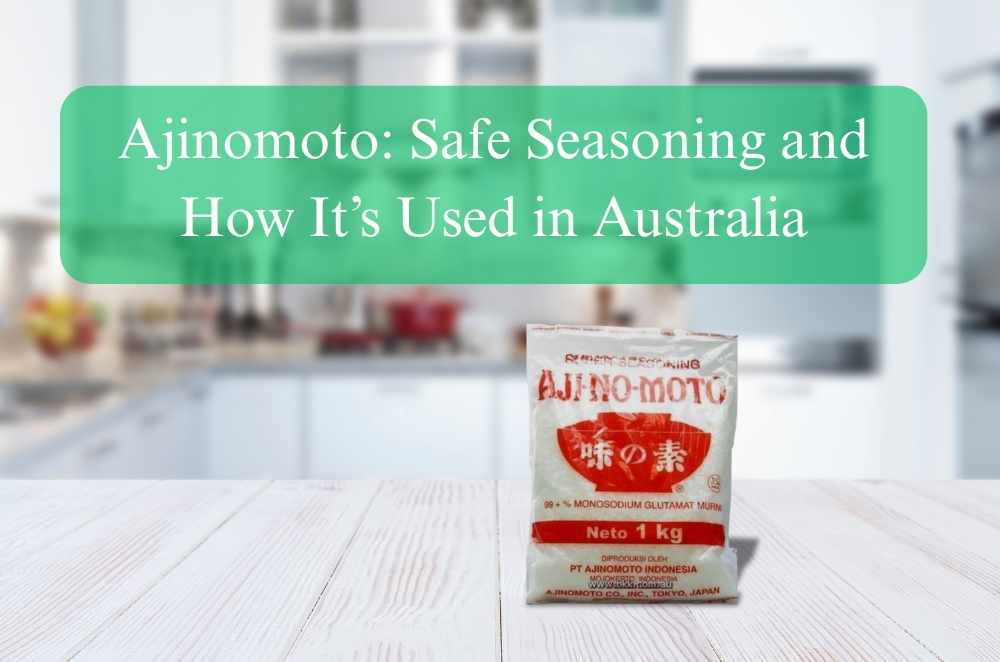
Ask around any busy Aussie kitchen, and you’ll hear the same thing: when you want clean, reliable savoury depth, you reach for Ajinomoto. Many cooks keep a small jar for pinch-and-taste moments, while producers buy in bulk for consistency. If you’re sourcing at scale, Ajinomoto powder is the straightforward option. It’s just monosodium glutamate (MSG) — the purified taste of umami — the same flavour note you get from parmesan rinds, ripe tomatoes, kombu and mushrooms. Used with a light hand, it doesn’t shout. It rounds. Softens the edges. Makes soups taste longer on the palate.
Now, quick housekeeping, so we don’t talk past each other. Ajinomoto is the brand. MSG is the compound. Umami is the taste. Keep those three in their lane, and everything else clicks into place.
From discovery to legacy: a quick origin story
The whole thing kicked off in 1908 when Japanese chemist Kikunae Ikeda isolated glutamate from kombu broth. Big deal, because chefs could now reach that same savoury “ahh, that’s it” without simmering seaweed all day. Ajinomoto turned the science into a product, then kept refining purity and process. Fast-forward a century: the crystals in your pantry are made through controlled fermentation, filtered, dried, and packed. Predictable as sunrise.
Does that matter here in Australia? Yep.
Consistency counts. Cafés, caterers and food manufacturers want the same result on a Wednesday arvo as they got on Monday morning.
Umami is a design tool. You plan for it like salt or acid — not a magic trick, just good craft.
Clear labelling rules. We’ve got a solid regulatory framework and plain-English guidance (more on that below).
A quick yarn from my side. I once reworked a beef-and-barley soup for a pub bistro in regional NSW. Good bones, decent veg. Still tasted a bit grey. We trialled 0.15% MSG by finished weight — weighed after simmering, stirred in off the heat. Suddenly, the barley and beef started singing from the same hymn sheet. Not louder; more in tune. The publican reckoned it tasted “like the cold day finally got a bit of sun.”
What MSG actually does to flavour
Glutamate locks onto umami receptors on your tongue. When that key turns:
Savoury notes get clearer and hang around longer.
Bitterness feels less pushy (handy with brassicas).
You can often use slightly less salt for the same perceived impact.
But let’s not get carried away. Good use is about calibration, not dumping it in with a shovel.
Start low. 0.1%–0.2% by finished weight in liquids is a tidy starting band.
Layer naturally. Pair with tomatoes, Parmesan rinds, shiitake, and miso.
Taste hot and warm. Temperature changes perceived intensity.
Balance the triangle. Salt sets the stage, acid sharpens the picture, and fat gives it somewhere to land. Umami ties it together.
I’ve done split-batch tests for a plant-based bolognese with mushrooms and lentils. With a pinch of MSG, I could back off the soy sauce, trimming colour and extra sodium. The version with Ajinomoto tasted meatier — not fakey — just more sure of itself.
Safety and labelling in Australia (no drama, just facts)
There’s a lot of folklore about MSG. Most of it doesn’t stand up under proper, modern scrutiny. In Australia and New Zealand, MSG is regulated as additive 621. If you add it, you label it. Simple. For a clear consumer explainer from the regulator — what MSG is, how it appears on packs, and how it’s assessed — see foods with msg in Australia
Practical notes for local operators:
Ingredient lists: Use “flavour enhancer (621)” or “monosodium glutamate.”
Front-of-house chat: “It’s purified glutamate — the same taste note as in parmesan and tomatoes.”
Allergy queries: Keep batch notes and offer an alternative on the spot — no fuss.
Training: Give staff a one-liner and a careful dose guide. Confidence beats waffle.
Home cooks posting on Medium? Note the measure (grams or teaspoons), mention it’s potent, and encourage readers to taste as they go. That’s the Aussie way: show them how, don’t lecture.
When Ajinomoto beats other umami boosters
We’ve got a whole pantry of savoury helpers: fish sauce, yeast extract, mushroom powders, Parm rinds. They’re brilliant when you want their personality. Ajinomoto is different — it’s targeted umami, clean and neutral.
Pick Ajinomoto when you want:
Lift without baggage. No sweetness, smoke or marine notes.
Batch reliability. Same dose, same result, even on a busy service.
Sodium tuning. Sometimes you can shave salt while keeping impact.
Diet clarity. Great for veg dishes where fish sauce is off the table.
Reach for other boosters when their character is brief:
Parmesan rind: nutty-dairy backbone.
Fish sauce: fermented depth for Southeast Asian profiles.
Shiitake powder: earthy bass notes.
Miso: savoury plus sweetness and umami haze.
Dosing Ajinomoto: rough-and-ready frameworks
No sacred numbers here, just starting points. Always taste; always adjust.
Quick side note, if you’ve ever wondered what is msg made of: it’s produced by fermenting sugars (often from sugarcane, sugar beets or molasses), then crystallising the glutamate — a process not unlike how soy sauce or vinegar is made.
Clear soups and broths: 0.1–0.2% by finished weight (about 2 g per litre to start).
Tomato sauces and braises: 0.08–0.15%; acidity reins in perceived umami.
Dry rubs: 0.5–1.0% of rub weight, mixed with salt, sugar, spices.
Snack seasoning: 0.3–0.6% depending on salt and fat.
Busting the old myths (gently)
So why do the stories stick? A mix of dated research, splashy headlines, and people blaming the wrong bit of a heavy meal. The way through isn’t snark. It’s hospitality plus facts.
If a diner asks, “Do you use MSG?” try this: “Sometimes, in small amounts — same taste note as parmesan. If you’d like a portion without added MSG, easy to do.” Calm. Honest. Human.
Writers and educators: point readers to neutral, official sources (see FSANZ above), share your process notes, and avoid miracle claims. Ajinomoto is a tool, not a talisman.
Further reading and internal resources (placeholders)
For home cooks, understanding Ajinomoto benefits—cleaner savoury depth, less reliance on salt, and a more satisfying finish—can lift weeknight soups and stir-fries from flat to “oh, that’s it.”
For a neutral science deep dive that unpacks fermentation and how glutamate interacts with receptors, point readers to what is msg made of so they can go down the rabbit hole without getting sold to.
Final thoughts
Pulling it together. Ajinomoto’s job is tidy: predictable umami. In Australia, you can use it with confidence, label it properly, and explain it in plain speech. Most of us already love the taste — it’s parmesan-on-pasta, tomatoes in late summer, mushrooms on toast. Ajinomoto is that flavour, measured and clean.
Here’s my go-to exercise. Cook your usual soup. Split it. Leave one half as is. In the other, stir in 0.12% Ajinomoto off the heat. Taste blind with a mate. Write down what shifted — not just “better,” but how. Longer finish? Less bitterness? A bit of “ahh, that’s it”? That little test teaches more than a stack of think pieces. And it’s kind of fun, to be honest.




Write a comment ...